Where West Virginia Drinking Water Comes From: Key Sources
If you are trying to understand what supplies your tap, the answer depends on the water system serving your address. A river, reservoir, groundwater well, or combination may be involved, and the source can differ from a nearby household’s. This guide explains the main source types, how they fit into the path to your faucet, and where to look for your supplier’s specific information.
Start With the Water System Serving Your Address
“West Virginia drinking water” is not a single supply. Public systems serve different communities and can draw from different sources; private wells serve individual properties or smaller groups. To find out where your water comes from, begin by identifying which kind of supply serves your home.
For a home connected to a public system, the name on a bill or service notice can help identify the supplier. If you rent, ask the landlord or property manager, or check the information provided for the building. In a subdivision or multi-unit property, the water supplier may not be obvious from the address alone, so confirm who operates the system rather than assuming that the nearest city utility serves it.
For a home with a private well, the source is usually tied to the well on the property. However, knowing that a home has a well does not by itself reveal the well’s depth, construction, condition, or water quality. Property records and the well owner may provide useful details, but testing is needed to evaluate water quality.
The distinction matters because the information available differs. Public water systems operate under federal and state requirements and generally publish consumer or compliance information. Private wells are not served by a public water supplier’s annual consumer report. Their owners need to arrange testing and upkeep themselves.
The West Virginia Office of Laboratory Services describes public water systems as Regulated by federal and state laws. The same office describes private wells as Little oversight. These descriptions point to an important practical difference: public-system records can help you understand a supplier’s sources and testing, while private-well owners should not assume that public-system monitoring covers their household supply.
If you are not sure whether your home is served by a public system or a private well, check a recent water bill, closing documents, rental records, or the property’s maintenance information. You can also ask the official supplier or the county health department which type of supply is associated with the property. Use the agency’s official website to find current contact details.
Once you know the supplier or source type, ask a more specific question: what source water does that system use? A town name, county, or nearby river is not enough to establish the answer. A supplier may serve multiple areas, and its sources may differ across service areas or change under particular operating conditions.
For help identifying a local supplier, see Finding Which Water Utility Supplies Your Charleston Household or How to Access Water Quality Records From Small Rural Utilities. For a broader overview of source types and treatment, see Surface Water vs Groundwater: How West Virginia Utilities Treat Tap.
Surface Water: Rivers, Streams, and Reservoirs
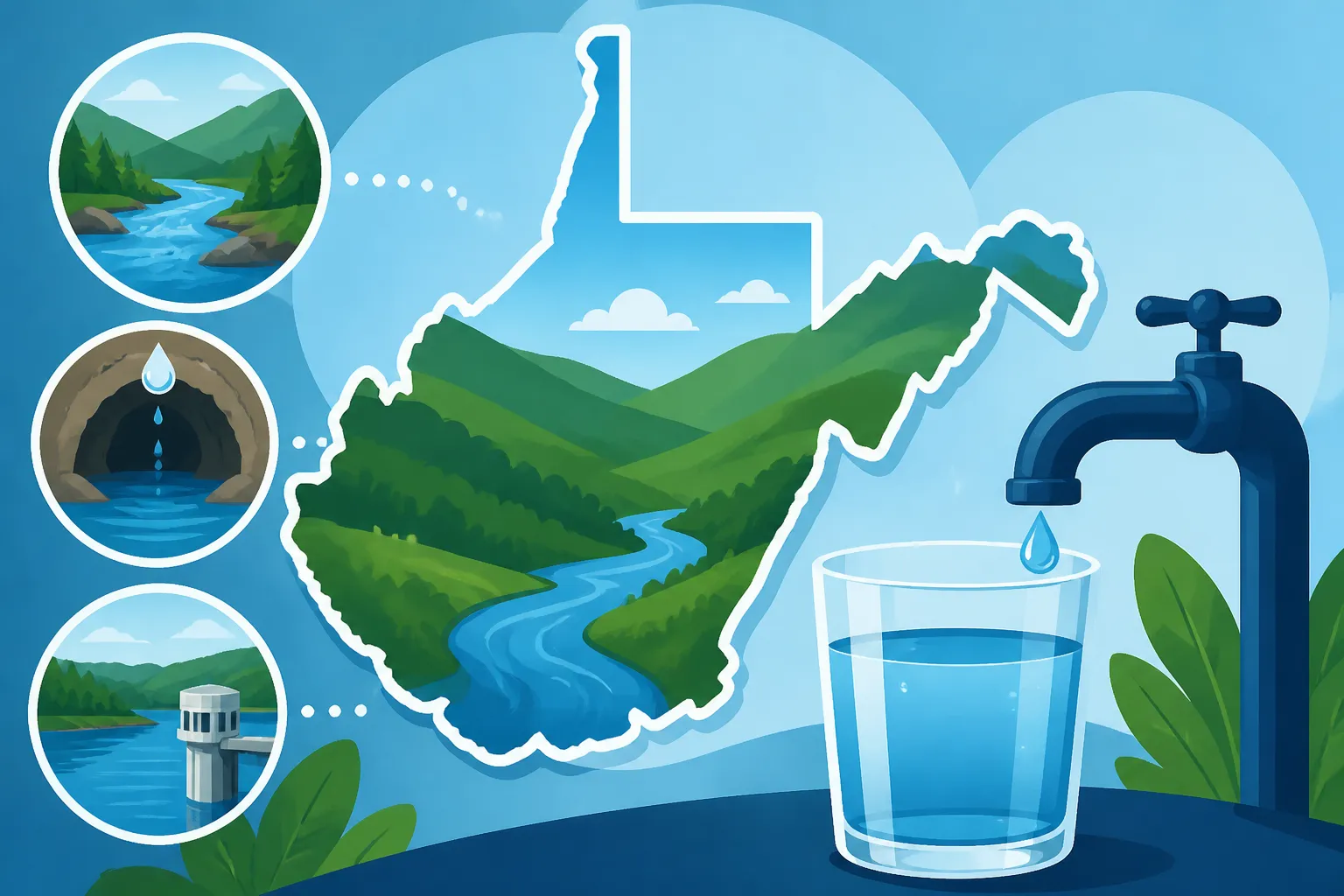
Surface water is water collected from sources at the land surface, such as rivers, streams, and reservoirs. A public water system that uses surface water typically collects it at an intake and sends it through treatment before distribution. The intake is the point where the supplier draws water from the source.
A river or reservoir is only the beginning of the drinking-water process. Source water is not the same thing as finished tap water. Suppliers treat water to meet applicable requirements and manage it through a distribution system before it reaches household plumbing. So a river’s appearance, smell, or recreational reputation cannot by itself tell you whether treated tap water meets drinking-water requirements.
Surface-water conditions can vary. Rain, runoff, changing river flow, seasonal conditions, and activity in the watershed may affect the raw water reaching an intake. These changes do not automatically mean tap water is unsafe, nor do they show that a treatment plant has failed. They are reasons utilities monitor source and treated water and communicate when an issue affects customers.
An intake can also be located away from the homes it serves. Water may be collected at a river location, treated elsewhere, and distributed over a service area. That means a nearby river is not necessarily the source for your tap. A utility may draw from a different river, a reservoir, a well, or a source that is not the closest one geographically.
Fairmont offers a documented example. According to the City of Fairmont, in the 2026 report, covering calendar year 2025, Fairmont’s source water is surface water from the Tygart Valley River intake. The report’s source wording is INTAKE-TYGART VALLEY RIVER Surface water. This identifies the reported source for Fairmont; it should not be treated as evidence that other West Virginia systems use the same source.
The source name can be useful even if you do not live in Fairmont. It shows the kind of detail to look for in a supplier’s report: the source type and the named intake or water body. If a report lists a river intake, that tells you where the system collects raw water. It does not, by itself, describe the treatment process, current water quality, or whether a specific home receives water from that intake at every moment.
For more about source locations and how they relate to supply, see How to Look Up Your West Virginia Community Water Intake Location and Managing Surface Water Intakes Across Major Appalachian Rivers. If you are interested in how suppliers respond to changing source conditions, How Water Treatment Plants Respond to Upstream River Spills offers related context.
Groundwater: Wells and Underground Sources
Groundwater is water held below the land surface in soil, rock, or other underground formations. A well draws from groundwater through a constructed opening. Public suppliers may use wells as part of a community system; private wells supply individual properties or other small-scale users.
The word “groundwater” describes where the water is found, not whether it is automatically clean, treated, or ready to drink. Groundwater quality depends on local geology, conditions around the well, and other factors. A well’s construction and maintenance also matter. Water that looks clear may still need testing to assess its quality.
A public system using groundwater is different from a household private well in how the supply is managed and documented. Public systems have regulatory and monitoring responsibilities. Private-well owners need to arrange appropriate testing and respond to the results. A nearby public system’s report cannot establish the quality of water from a private well, even if both draw water from the same general area.
Groundwater may also vary from property to property. The geology beneath one lot can differ from that beneath another, and nearby wells may not have identical construction or draw water from precisely the same conditions. A neighbor’s test result can be a helpful point of comparison, but it is not a substitute for testing your own well.
For a private well, start by locating available well records and gathering information about the well and its maintenance. Then choose testing based on the reason for testing, such as routine monitoring, a change in the water, or a property purchase. A laboratory or qualified local professional can help determine which tests make sense. Do not choose treatment equipment based only on an assumption about the source or on a neighbor’s results.
A test result is only useful if you know what it covers. A basic screening panel may not assess every concern that could be relevant to a particular property. If the well is near a potential source of contamination, has a persistent odor or color change, or is being evaluated during a home purchase, ask a qualified professional or local health department what additional testing may be appropriate.
Private-well owners can find more detail in Guide to Testing a Private Well and Choosing a Lab in WV, What to Test for in West Virginia Private Well Water, and Well Water Testing Checklist When Buying a West Virginia Property. Those topics address testing and records; they do not replace advice based on the conditions of a specific well.
A Source Is Not the Same as the Water at Your Faucet
A source report answers where a supplier obtains raw water. It does not provide a complete description of what happens between the intake or well and your kitchen tap. For public water, that path can include treatment, storage, and distribution through pipes. At a property, household plumbing can affect water after it enters the building.
This distinction is important when interpreting a report. A source-water designation such as “surface water” identifies a broad source category. A named river intake identifies a collection point. Neither tells you, by itself, which contaminants were tested, what results were recorded, or what condition the water is in at a particular faucet.
Likewise, a test from a public system is not the same as a test of a private well or of water inside one home’s plumbing. Public suppliers sample and report under the rules that apply to their systems. Household conditions, such as the materials and age of plumbing, may require a separate investigation. A utility’s general report cannot show exactly what has happened to water inside an individual building.
For a public system, the Consumer Confidence Report or annual water quality report is a good starting point. It may identify source water and summarize monitoring results. Read it for the correct supplier and service area, because one company or system may publish information for more than one location. If a report does not make your service area clear, ask the supplier to confirm which report applies to your address.
For help locating and understanding these documents, see How to Find Any West Virginia Water System’s Annual CCR Report, How to Check if West Virginia Tap Water Meets Drinking Standards, and How to Read Contaminants in a West Virginia CCR. A report can help answer questions about the system, but it should not be treated as a real-time reading from your tap.
If your concern is specifically about household plumbing, source-water information is only part of the picture. A service line or internal pipe may affect water after it leaves the public system. The utility’s source and treatment records will not identify every material inside a home. See Guide to Utility Lead Service Inventories and Homeowner Pipes for more on tracing that part of the water’s route.
How to Find the Source for Your Water Supplier
Finding a source is usually a records question, but it helps to work through it in order. First establish which system serves the property, then look for that system’s report or source-water information. If the source is still unclear, ask the supplier to confirm the applicable service area and source designation.
- Identify the supplier. Check a water bill, service notice, lease, or property records. If the building has a master meter or the bill is handled by a landlord, ask who provides the water to the building and whether it is public-system water or a private supply.
- Match the report to the service area. Look for the system name and the location or customers covered by the report. Do not assume that a report for a nearby city or a similarly named utility applies to your address.
- Find the source description. Search the report for wording about source water, source type, intake, well, or water supply. A report may give a named river or intake, or it may describe a different kind of source.
- Separate the source from test results. Note where the raw water comes from, then review the report’s water-quality information separately. One section describes the source; another may summarize treatment and monitoring.
- Ask for clarification when details are missing. If the report names several sources or does not clearly explain which applies to your area, contact the official supplier using current details from its official website.
- For a private well, locate well records and arrange testing. A public utility report will not substitute for a test of the well that supplies your property.
For broad help finding records, How to Look Up Drinking Water Quality Test Results in West Virginia and Finding Past CCR Reports to Track Utility Improvement Over Time can help you navigate the available information. If the question is about which utility serves a specific household, use an address-based confirmation from the supplier rather than relying on a neighbor’s account.
It is useful to keep a record of the supplier’s answer and the report you reviewed. If you move, change landlords, or discover that a property is served by a different system than expected, revisit the source information. A source description is tied to a supplier and service area, not to a whole county or state.
If the supplier confirms that its source information is unavailable or difficult to interpret, ask what document identifies the current source. The official utility or agency website is the right place to find current records and contact details. Avoid relying on an old report without checking that it covers the relevant period and location.
What Source Information Can—and Cannot—Tell You
A source description provides useful context, but it is not a complete safety assessment. It can tell you whether the supplier reports a river, reservoir, or groundwater source and may identify an intake or well. That information helps you understand the supply pathway and find the right report.
It cannot show whether a particular glass of water has a contaminant, whether the condition of a household pipe is affecting water, or whether there is an active advisory. For current operational information, check the supplier’s notices and official communication channels. For a household concern, consider whether the issue calls for a utility inquiry, plumbing inspection, or water test.
A surface-water source does not automatically mean a problem is present. Nor does groundwater automatically mean water is free of contaminants. The source category describes origin, not a verdict on quality. The relevant evidence comes from appropriate monitoring, testing, and current supplier information.
A source listing also does not establish that every customer receives water from only one source. Some systems may have multiple sources or operational arrangements. Do not infer blending or system configuration unless the supplier’s report explains it. Ask the utility which source or sources apply to the service area in question.
If you are comparing two towns or suppliers, compare like with like. Make sure the records cover the same type of system and relevant service area, and keep source information separate from test results, treatment descriptions, and compliance notices. A difference in source type does not by itself mean one supply is better or worse.
For public water concerns, reviewing reports alongside current notices gives a more complete picture than relying on a source label alone. See Guide to West Virginia Drinking Water Quality and Compliance and Checking Violations and Water Tests on West Virginia Public Systems for help understanding related records.
For private wells, a source label is even less informative about present water quality. The fact that a property draws groundwater does not answer whether the water has been tested for the concerns relevant to that location. Testing and interpretation should be based on the well, property, and reason for concern. If the result raises health questions, contact the local health department or a medical professional rather than trying to make a health decision from the source type.
Frequently Asked Questions
Does every West Virginia home get water from a river?
No. The source depends on the system serving the property. A public supplier may report a surface-water source or groundwater source, while a private home may use its own well. Confirm the source with the supplier or review the applicable report.
Does a nearby river tell me where my tap water comes from?
Not necessarily. A supplier’s intake may be elsewhere, or the property may be served by another source type. Check the supplier’s report or ask the utility to confirm which source applies to the address.
Is groundwater automatically safe to drink?
No. “Groundwater” describes where the water originates, not a test result. Private-well owners should arrange appropriate testing and seek qualified help interpreting results.
Can a public water report tell me what is in my home’s pipes?
Not completely. A system report describes supplier-level information; it does not identify every pipe or fixture inside a home. If plumbing materials are a concern, review service-line records and consider a qualified plumbing assessment or household water testing.
Sources
- West Virginia Office of Laboratory Services — Environmental Chemistry (checked November 14, 2026)
- City of Fairmont — Fairmont-Consumer-Confidence-Report-2025 (checked November 14, 2026)
Disclaimer
This article is for general informational purposes only and does not constitute professional advice. Laws, prices and regulations vary by location and change over time. Consult a qualified professional for guidance on your specific situation. West Virginia Water Guide is not a government agency or water utility and is not affiliated with any public water system.