West Virginia American Water Quality Reports by Service Area
West Virginia American Water serves more than one water system, so a report for the company may not be the report for your tap. The key is matching your service address to the correct service area, then reading that area’s water-quality report with its limits and sampling details in mind.
Why the service area matters
A water-quality report, often called a Consumer Confidence Report or CCR, describes the drinking water supplied by a particular public water system. It is not a single statewide result for every customer of a company. Water sources, treatment processes, monitoring results, and system boundaries can differ from one service area to another.
That distinction matters when you search for a report. A report with “West Virginia American Water” in its title may cover a system that is not connected to your address. A nearby town or neighborhood may have a different supplier, even if the provider’s name sounds familiar. Some areas may also have separate systems or operational arrangements that affect which report applies.
The correct report is the one that covers the water system serving your home or business. If you are unsure which utility supplies your tap, start with your bill or account information. You can also use Finding Which Water Utility Supplies Your Charleston Household if you live in Charleston, or How to Find Any West Virginia Water System’s Annual CCR Report for a broader search approach.
A report is useful for understanding the utility’s monitored drinking-water results and compliance record. It does not test the plumbing inside your home. Water can change as it travels through service lines, building plumbing, faucets, and fixtures, so a utility report cannot tell you exactly what is coming out of every tap.
How to find the report for your address
Start with the provider’s official website and look for a water-quality report, Consumer Confidence Report, or service-area report section. The page may let you search by ZIP code, community, or system name. If an address lookup is available, use the full service address rather than relying only on a city name.
If the site does not offer a direct address search, use this process:
- Check your water bill or account. Look for the utility name, service location, and any system or district label. A billing name may identify the company but not the exact water system.
- Search the provider’s report page by location. Try the community name and ZIP code, but treat the result as a candidate until you confirm the service area.
- Match the report’s system name to your service address. Look for a coverage description, map, or list of communities. If your location is near a boundary, do not assume that the nearest report applies.
- Check the report period and publication details. Confirm which monitoring year the report covers and whether it is the newest report available for that system.
- Ask the provider to confirm if the match is unclear. Use the current contact options on its official website. Give the service address and ask which public water system and report apply.
A ZIP code is a useful starting point, but it is not always a reliable boundary for water service. ZIP codes are designed for mail delivery; water-system boundaries follow infrastructure and service arrangements. Two nearby streets—or even parts of the same community—can be served by different systems.
If a report page provides a downloadable document without a clear address search, look inside the document for the system name, service-area description, and customer contact information. Avoid treating a report as yours merely because it mentions a familiar city or the same utility.
For more help identifying a report by location, How to Look Up Your WV American Water Report by ZIP Code focuses on using a ZIP code as a search tool and checking the result against the system information. If the provider’s site does not make the match clear, the utility can confirm the correct system.
| What to check | Why it matters | What to do if it does not match |
|---|---|---|
| Utility name on your bill | Confirms the provider listed for your account | Check whether the bill names a separate system or district |
| Service address | Identifies the location whose water service you need to verify | Use the full address when asking the utility |
| System or service-area name | Connects the report to the water system that serves you | Do not rely on the company name alone |
| Coverage description or map | Helps show where the report applies | Ask the provider about boundary streets or unclear coverage |
| Report’s monitoring period | Shows which period the results describe | Look for a newer report or confirm whether one is available |
| Report title and system identification | Helps distinguish similar reports | Search the exact system name, not only the town name |
What a water-quality report tells you
A CCR is designed to summarize information about the water system’s source, treatment, monitoring, and compliance. The layout can vary, but the report commonly identifies the water source, lists detected regulated contaminants, explains applicable standards, and describes any violations or required corrective actions.
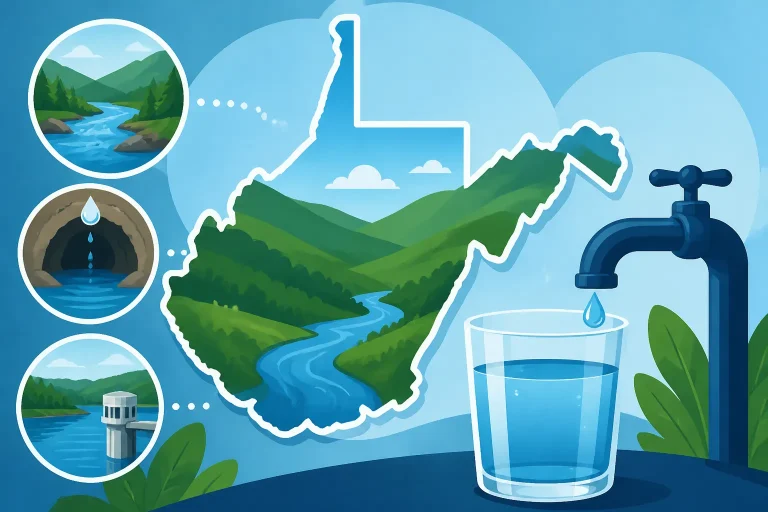
The source section may say whether the system uses surface water, groundwater, or a combination. It may also summarize how the source is treated and where customers can find additional source-water information. The details are specific to the system named in the report; do not assume that another service area uses the same source or treatment.
The results section often includes a table of regulated contaminants monitored during the report period. Depending on the contaminant and applicable monitoring rules, the table may show a result, a range, a detection, or a compliance measure. It may also include the regulatory limit or an explanation of how to interpret the entry.
A result in a CCR is not necessarily a measurement from every home. Many public-system tests are collected at designated sampling points or locations under monitoring requirements. The report describes those monitoring results and the system’s compliance status; it does not provide a customized test of your kitchen faucet.
Reports may also explain contaminants that were detected at levels allowed under applicable standards, or describe contaminants that were not detected during the required sampling. “Not detected” does not mean that every possible substance was tested for, or that the substance could never be present. It means the reported monitoring did not find it at or above the relevant detection level in the samples taken.
The report may include definitions, acronyms, and notes about monitoring frequency. Those details can be important. For example, a value may represent a range, an average, or a result calculated in a particular way, rather than one isolated sample. Review the table notes before comparing numbers across systems.
For a step-by-step approach to the report itself, see How to Read Contaminants in a West Virginia CCR. You can also use Interpreting Disinfection and Chemical Results in a Local CCR when a result or treatment-related term is unfamiliar.
How to read results without overinterpreting them
CCR tables can look technical because different contaminants are measured and reported in different ways. Start by identifying the contaminant name, the units, the reported result, and the standard or comparison value shown in the same row. Then read the footnotes and definitions before drawing a conclusion.
A few distinctions help:
- Detection is not the same as a violation. A contaminant can be detected while the system remains in compliance with the applicable drinking-water standard.
- A reported maximum may not describe every sample. The table may show the highest result, a range, or another summary measure specified for that contaminant.
- Units matter. Do not compare two figures unless they use the same units and the same reporting basis.
- A blank or dash needs context. It may indicate that no result is listed, that the contaminant was not detected, or that the table uses another convention. Check the report’s notes.
- Different contaminants use different rules. A number that is meaningful for one contaminant cannot be interpreted using another contaminant’s limit or reporting method.
A CCR may also distinguish between a maximum contaminant level, a treatment technique, an action level, or another regulatory measure. These are not interchangeable terms. If you are unsure what standard applies to an entry, use the report’s glossary or consult the official utility or drinking-water regulator information.
When comparing reports, compare like with like. Confirm that the reports cover similar monitoring periods, that the same contaminant and units appear in both, and that the numbers are expressed on a comparable basis. A high or low figure on its own does not explain risk, treatment performance, or what is happening in an individual home.
The article How to Check if West Virginia Tap Water Meets Drinking Standards explains how to approach compliance information. For an overview of how results fit into public-system monitoring, see Guide to West Virginia Drinking Water Quality and Compliance.
How to understand violations and notices
A report may say that a system had a violation, missed a monitoring requirement, or took corrective action. Read the specific entry rather than treating every violation as the same kind of event. A monitoring or reporting violation can mean that required sampling or paperwork was not completed as required; it does not automatically mean that a contaminant was found above a limit.
If the report lists a contaminant-related violation, look for the contaminant, the period involved, the affected system, and the corrective action or explanation. The report may describe whether the issue was resolved and whether customers were notified. If the wording is not clear, contact the provider or the relevant drinking-water regulator using current details from its official website.
A CCR is an annual summary, not a live alert tool. It may describe a past monitoring period and may not show a short-term event that occurred after the report was prepared. For current advisories, check the provider’s active notices and official alert channels. Checking West Virginia American Water’s Live Advisory Map is relevant if you need to check the provider’s current map, while Managing Water Advisories and Boil Orders Across West Virginia explains how to respond to an advisory.
If an advisory is active, follow its instructions rather than relying on an older annual report. If a notice has been lifted, use the official notice or provider instructions for any follow-up steps. A report showing routine compliance cannot override a current notice for a specific area.
What the report cannot tell you about your home
A utility report describes the public water system’s results. It does not establish the condition or water quality of every private service line, household pipe, faucet, or appliance. Plumbing materials can affect water between the utility’s sampling point and your tap.
Lead is an important example. A system-level report can provide information about monitoring and compliance, but it cannot determine whether a particular home has a lead service line or whether water has picked up lead from household plumbing. Lead cannot be reliably identified by looking at, smelling, or tasting water. If your concern is lead, review Guide to Utility Lead Service Inventories and Homeowner Pipes and How to Check if Your West Virginia Home Has a Lead Service Line. A service-line inventory and a household water test answer different questions.
Likewise, a CCR does not evaluate the taste, odor, hardness, or staining you notice at home in the same way a household assessment would. Some properties have older plumbing, private water equipment, or plumbing conditions that differ from the rest of the service area. A utility report is a useful starting point for understanding system-wide information, but it is not a substitute for a home-specific test when one is needed.
If you are considering a filter, start by identifying the issue you want to address. Match a product’s certification and reduction claims to the contaminant or characteristic shown by a suitable water test or verified report result. No filter treats every possible issue, and a product’s general label is not enough to establish that it is appropriate for your home. See When Should You Filter Municipal Tap Water in West Virginia? for a practical overview.
For health questions about a particular contaminant or your exposure, ask your local health department or a medical professional. A CCR is a public information document, not personal medical advice.
Comparing reports across West Virginia American Water service areas
Comparing service-area reports can help you understand how systems differ, but it is easy to make an unfair comparison. One system may use a different source, have a different treatment process, or follow a different sampling schedule. A single value does not tell the whole story.
Before comparing two reports, check the following:
- Confirm both systems. Make sure each report applies to the service area you mean to compare, not merely to the same company.
- Match the monitoring periods. A report for one period should not be compared casually with a report covering a different period.
- Compare the same contaminant and units. Similar-sounding entries can have different definitions or measurement units.
- Check how each result is summarized. A maximum, range, average, or other statistic may not be directly comparable to a different reporting format.
- Read the notes and compliance status. A number without the table’s context can give a misleading impression.
- Separate system data from household plumbing. Differences between public-system reports do not establish what is present at an individual faucet.
Differences between reports are not automatically evidence that one service area is safer or less safe. They may reflect genuine differences in source water, treatment, or monitored results, but the report’s standards and explanatory notes are necessary to interpret them. How to Compare Drinking Water Quality Across West Virginia Systems provides a broader framework for making those comparisons.
It can also help to look at reports over multiple periods for the same system. Trends may offer more context than a one-time result, especially when a report explains a treatment change or corrective action. Keep in mind that report formats and monitoring requirements can change, so read the notes for each period rather than comparing figures mechanically. Finding Past CCR Reports to Track Utility Improvement Over Time covers how to use older reports as context without treating them as current results.
Frequently Asked Questions
Does one West Virginia American Water report cover every customer?
Not necessarily. The provider may publish reports by water system or service area. Use the report that matches the system serving your address, and confirm with the provider if the service-area boundary is unclear.
Can I use my ZIP code to choose a report?
A ZIP code can help narrow the search, but it does not define water-system boundaries. Check the report’s system name and coverage information, or ask the utility to identify the correct report for your service address.
Does a CCR show what is in the water at my faucet?
No. A CCR summarizes public-system monitoring and compliance information. It does not test your home’s plumbing, service line, or specific tap. Home-specific concerns may require a separate test.
Does a detected contaminant mean the water violated a standard?
Not by itself. A contaminant can be detected without a violation. Check the result, units, applicable standard, report notes, and compliance section for the context.
Is an annual report enough to check for a current water advisory?
No. A CCR summarizes a reporting period and may not include a newer event. Check the provider’s current notices and follow any active advisory instructions.
Disclaimer
This article is for general informational purposes only and does not constitute professional advice. Laws, prices and regulations vary by location and change over time. Consult a qualified professional for guidance on your specific situation. West Virginia Water Guide is not a government agency or water utility and is not affiliated with any public water system.